































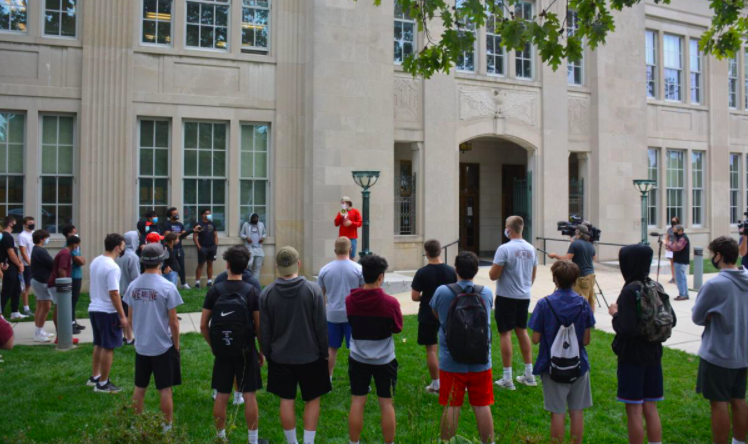

Amongst the frantic rush to submit course preferences—and remembering to attend course selection meetings with guidance counselors—sophomores like me face a dilemma. The minute an underclassman makes the decision to stay at Harriton for their high school experience, they know the choice of participating in the International Baccalaureate (IB) program is a very real one.
When to Make a Decision
Harriton’s students are blessed to have the opportunity to select from two paths for their junior and senior year: the Advanced Placement (AP) path—which most U.S. high schools offer—or the IB path. While most of these classes are taken by upperclassmen, freshmen and sophomores should already be thinking about it.
For freshmen, if you know you want to take IB, it’s highly recommended to take US Government in your sophomore year, as it is a requirement for graduation. Then in sophomore year, you make the final decision mid-year, whether you’re doing IB or AP.
The AP Path
The AP program’s founding goes way back to the Cold War in the 1950s. In another attempt to trounce the Soviet Union, America’s policymakers wanted their students to excel, and so came forth the Ford Foundation with the Fund for the Advancement of Education (FAE). The FAE created AP exams as a way for high school students to take college-level courses, and therefore become more educated and qualified. They passed off control to College Board in 1955, and in the 1960s, focus on the AP classes and methodical grading increased in order to normalize consistency.
In 2025, there were 470,000 students who registered to take an AP test. From Harriton, we had 413 students out of a little more than 1,000 who registered for at least one AP test. Keep in mind, at least a quarter of that population did not take an AP test due to being an underclassman.
The grading system for AP tests is a scale from 1-5. According to College Board, your score shows “how qualified you are to receive college credit and placement.” A 5 means you are above-and-beyond qualified, equivalent to an A+. Conversely, getting a 1 means a flat-out no recommendation. In order to be qualified for that subject, you must get a 3 or above. Harriton has a pretty good record from last year for AP scores: 94% of those tests were a 3, 4, or 5.
But then again, not all Harriton students take AP classes.
The IB Path
As the AP program was developing their agenda in the 1960s, the IB program was just getting started. IB was a different approach to learning: instead of passive students who just accepted everything their teachers told them, IB promoted students to be the center of the learning and to interact within their classrooms.
In 1962, international social studies teachers, known as the International Schools Association (ISA), held a conference in Geneva to help push for these ideals. Influenced by John Dewey, A.S. Neill, Jean Piaget, and Jerome Bruner, the program is intended to increase critical thinking and analysis, specialization in certain studies, and the beauty of education for learning, not memorization.
After 6 years, the IB program was officially recognized. It incorporates a Theory of Knowledge (TOK) class along with Creativity, Action, and Service (CAS) hours. 7 years after that, the official IB diploma was introduced and the International Baccalaureate North America (IBNA) was established—think of it as the equivalent of College Board.
A big part of the program is their mission statement:
The International Baccalaureate aims to develop inquiring, knowledgeable and caring young people who help to create a better and more peaceful world through intercultural understanding and respect. To this end the organization works with schools, governments and international organizations to develop challenging programmes of international education and rigorous assessment. These programes encourage students across the world to become active, compassionate and lifelong learners who understand that other people, with their differences, can also be right.
In addition to that, their Learner Profile is just as important, which details 10 characteristics the program hopes to instill in their participants.
In 2025 for Harriton, there were 108 students who took an IB test. An IB student takes a DP assessment for each subject. Each assessment score ranges from 1-7, and the total from all subjects are added up along with the Extended Essay and TOK Essay. The highest score a student can get is a 45.
Any student who completes the three essentials (TOK, Extended Essay, and CAS) and gets a score of at least a 24 will receive a diploma. For Harriton, 77% of the tests received a 4, 5, 6, or 7.
Which Is Right for You?
AP and IB classes differ completely in structure. AP classes revolve around the test, which is taken in the beginning of May. They are offered in a range of subjects, and of course, the bonus is getting college credit.
While the IB program has a test at the end of the classes, they are organized differently; they revolve around the student. Regarding the differences in structure, some are 2-year long courses, some have different levels–higher level (HL) or standard level (SL)–and if you receive this diploma, you have the chance to attend an international college.
If you’re a freshman reading this, you’ll get more information on the difference between these classes later—don’t fret. If you’re a sophomore, you’ve missed the deadline to apply for IB, sorry! And if you’re a junior or senior, then you’ve already picked your poison.
As a sophomore myself, I’ve heard of some major pros and cons for both. I chose the AP direction because I’m accustomed to it and it fits my style of memorization. An appealing trait of the IB curriculum is that it is more essay-based, which interested me as a strong English student. Also, the opportunity to take IB is a rare one, since most schools in the US just offer AP classes. The breaking point for me was that I wasn’t sure I wanted to stay with the same group of people for two years and change my whole learning style.
What there’s no dilemma about, though, is that both are a lot of work. From what I’ve heard, IB and AP are about the same amount of work in different forms.
Whatever path you decide to take—AP, IB, or neither—make sure it’s the right path for you. Choose wisely!