























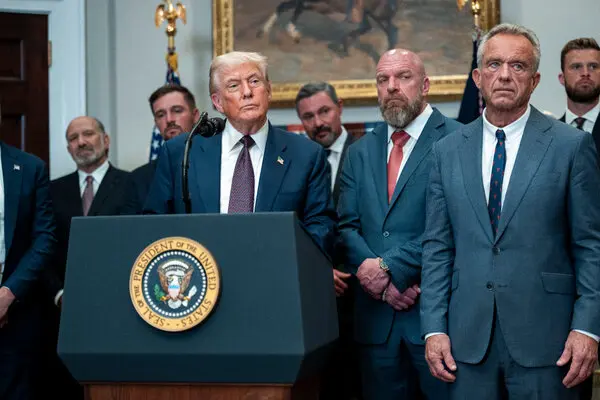
Generations of US adults look back to their youth and remember the grueling presidential fitness test, originally introduced by Lyndon B. Johnson in 1996 to “create school based programs that reward excellence in physical education”. The test took many forms over its years, but the most recent version consisted of a one-mile run, sit-ups, a 30-foot shuttle race, a sit and reach flexibility exam, and an option between pull-ups or push-ups. While it was retired in 2012 by the Obama administration, on July 31st, Trump signed an executive order to reestablish the test in public schools. His administration aims to “address crisis levels of childhood obesity, sedentary behavior, and poor nutrition”.
While President Dwight D. Eisenhower built the exercise test after learning, in a 1965 study, that 58% of American children were unable to pass at least one of six fitness exams, it was President Lyndon B. Johnson who later created the Presidential Physical Fitness Award. Under this new program, students who were in the 85th percentile in all of the tests were eligible to earn the Presidential Physical Fitness Award. This honor exhibited the Presidential Seal and was meant to showcase national excellence.
After the 2012-13 school year, The Obama Administration transformed the fitness test into the Presidential Youth Fitness Program, which gave “training and resources to schools for assessing, tracking, and recognizing youth fitness.” Although the Obama administration shifted the exam away from competition and more towards building long-term health habits, the Trump administration has argued that this approach has not done enough to combat obesity rates.
“President Trump wants every young American to have the opportunity to emphasize healthy, active lifestyles—creating a culture of strength and excellence for years to come,” White House press secretary Karoline Leavitt has said in a formal statement. Recently, the Department of Health and Human Services released a report that stated American children are facing high levels of chronic diseases, mainly caused by a sedentary lifestyle and a poor diet. It also called for a nationwide push against what Secretary of Health and Human Services, Robert F. Kennedy Jr, has called a “health emergency”.
Many supporters agree that a nationwide competition can encourage students. At the signing ceremony, Kennedy argued that “re-instill[ing] [the] spirit of competition and that commitment to nutrition and physical fitness” will be beneficial. Vice President JD Vance elaborated that the reinstatement was part of a broader shift to motivate our kids to do better and be healthier.
However, others debate that the test isn’t effective, because its task-specific style is not promoting overall improvement towards a balanced lifestyle. Additionally, concerns about its psychological impacts on children have resurfaced. Some warn that it risks shaming students who can’t meet the criteria and potentially creating an environment of body negativity in schools, which is dangerous as body image issues can begin as early as 3. Many educators, including Kathy Hirsch-Pasek, approve an official fitness test for children but would rather give motivation for children to surpass their own former records rather than other classmates.
A few teachers interviewed by NPR revealed that, while the structure and specifics of the exam are currently unknown, they would like to see that the test encourages students to spend more time being active to form lifelong, healthy habits. “I think the biggest thing is that right now we have child fitness at the forefront,” Laura Robison, a professor in the School of Kinesiology at the University of Michigan, said. “And that is what we need to be focusing on: How do we help kids get to where we want them to be, less about the test and more about how we get them there.”